(C) Diliff, CC BY-SA 3.0, https://commons.wikimedia.org/w/index.php?curid=35972521
Miscellaneous  |  03/25/2019

"More Harm than Good"

On 26 March, the European Parliament votes on the EU Copyright Reform. Valentina Moscon and Reto M. Hilty have analyzed the legal consequences of the planned reform. In an interview, they explain why the planned directive misses its central objective.

(C) Diliff, CC BY-SA 3.0, https://commons.wikimedia.org/w/index.php?curid=35972521
European Parliament, Foto: Diliff (commons.wikimedia.org), CC BY-SA 3.0

Valentina Moscon, Senior Research Fellow at the Max Planck Institute for Innovation and Competition in Munich, and Director Reto M. Hilty lead the project group for the modernization of copyright law. The legal experts have already analyzed the effects of the planned reform at an early stage of the legislative process in a statement and compared them with the current draft resolution. Their conclusion: the directive misses its central objective over long stretches.
Link to the interview (in German)

The proposed Directive 2016/0280 COD aims to adapt copyright law to the digital age and the digital internal market in order to keep pace with technological progress, changing user behaviour and new business models.

Two articles of the planned directive have been particularly criticized: Article 11, which in its current version has become Article 15, provides a neighboring right for press publishers throughout Europe. News services will pay press publishers for short text excerpts from press articles - so-called snippets - on their pages. Article 13 - now Article 17 - is also controversial: it provides liability of commercial platforms such as Youtube and others for unauthorized uploading of copyrighted works by its users.

More Information:
 

”Europe Might Miss Chance For Real Copyright Law Modernization”: Interview with Prof. Reto M. Hilty
”Eine neue Kultur”:  Interview with Prof. Reto M. Hilty (in German)
Position Statement

Data Access and Control in the Era of Connected Devices (Cover)
Study  |  03/20/2019

New Study: Data Access and Control in the Era of Connected Devices

The one thing all smart devices need – whether in industry, agriculture, or the common household – is data. In his new study, Josef Drexl proposes guidelines for the the future EU legal framework for the digital economy.

On behalf of the European Consumer Organization BEUC, Josef Drexl has authored a study on data access and control in the era of connected (smart) devices.
 

The study comprehensively analyses the interface of existing and evolving intellectual property legislation (with a focus on sui generis database rights), trade secrets protection, and data and consumer protection rules for discussing the future legal regime for data generated and processed in an Internet-of-Things environment.


In line with earlier Position Statements of the Institute, the study rejects legislation on data ownership rights. Furthermore, it explores the possibilities and core requirements for a general data access regime on the EU level, which would complement competition rules and could be spelt out more concretely in the framework of sector-specific data access regimes.
 

See Study: Data Access and Control in the Era of Connected Devices

Miscellaneous  |  03/19/2019

Artificial Intelligence – Perspectives for Germany

On the occasion of the opening of the German Research Summit 2019, Dietmar Harhoff points out in his keynote, that the German AI Strategy needs more agility in politics.

Source: German Research Summit 2019

The keynote is available here (in German).


The German Research Summit annually gathers around 400 decision-makers, experts, thought leaders, and newcomers in science, economics, society and politics to discuss the further development of the German innovation system. It is organized by the Stifterverband, a joint initiative started by companies and foundations promoting education, science and innovation in Germany as well as the National Academy of Sciences Leopoldina and the Commission of Experts for Research and Innovation (EFI).


The special focus of the German Research Summit 2019 is on Artificial Intelligence (AI).


More on AI by Dietmar Harhoff:
„Outline for a German Strategy for Artificial Intelligence“ by Dietmar Harhoff with Stefan Heumann et al.
Künstliche Intelligenz – Neue Forschungsbündnisse, Kurzkommentar von Dietmar Harhoff und Stefan Heumann im ZBW Wirtschaftsdienst

Prof. Dr. Reto M. Hilty
Miscellaneous  |  03/12/2019

EU and Switzerland: Neighbouring Right for Press Publisher under Criticism

Despite the controversy surrounding the European Parliament’s proposal to introduce a press publishers' neighbouring right, Switzerland has now tabled the same proposition. A group of Swiss legal scholars including Reto M. Hilty show why such a right does more harm than good.

Prof. Dr. Reto M. Hilty

The planned introduction of a neighbouring right for press publishers is based on a proposal from the Swiss Media Association. In the preparatory Commission for Science, Education and Culture of the Swiss Council of States  the proposal was approved. Similar to Article 11 of the proposed Copyright Directive of the EU, the Swiss proposal envisions having news service providers pay a remuneration to Swiss press publishers when they lead readers to them via short linked texts, or “snippets”.
 

The fact that the proposal for a neighbouring right for press publishers (Article 37a of the Swiss Copyright Act) was put forward so late in the legislative procedure drew both from legal scientists and from the creators. The country had so far always shown a wait-and-see attitude when it came to adopting EU regulations.
 

Prof. Dr. Reto M. Hilty, Director at the Max Planck Institute for Innovation and Competition in Munich and full professor at the University of Zurich, states: “That our copyright needs modernizing is undisputed. It has to be adapted to new lifestyles and user behavior in keeping with the times (e.g. in social networks), but also to new business models.” In a statement addressed to the Council of States, Hilty and his co-authors Prof. Florent Thouvenin (also University of Zurich) and Prof. Cyrill P. Rigamonti from the University of Berne, demonstrate the effects of the planned reform. “Modernizing copyright does not mean changing its intended purpose. Even in the digital age it is primarily supposed to provide an appropriate protection for those creating the content. The protection of the creators, however, cannot be equated with an exaggerated protection for those companies commercializing copyrighted content.”
 

In a first debate at the Council of States on Tuesday, the small chamber returned the proposal back to the preparatory Commission.


The Max Planck Institute in a position statement dealt intensively with the legal repercussions of the EU copyright reform at the very beginning of the European legislative procedure. Prof. Reto M. Hilty also criticized the current compromise proposal in an interview before the final vote in the EU Parliament scheduled for the end of March. The copyright expert explained that the legislation has lost sight of the goal of modernizing copyright law.
 

Link to Position Statement concerning the Swiss Copyright Reform

Link to Position Statement "Modernisation of European Copyright Rules"

Link to Interview

Miscellaneous  |  03/02/2019

”The current compromise does not provide clarity and consistency”

Neighbouring rights and platform liability: The European copyright reform entails far-reaching changes. In the view of the managing director, Prof. Dr. Reto M. Hilty, the key concerns of the reform have not been implemented even with the compromise proposal. He explains the reasons in an interview.

Photo: Charles (unsplash.com), CC0

The Max Planck Institute for Innovation and Competition had already commented at an early stage of the legislative process commented on the EU Commission's proposal for a Directive on Copyright in the Digital Single Market in a comprehensive statement of September 2017 and suggested amendments.


Following the February compromise between the EU Commission, representatives of the European Parliament and the EU Member States, an amended version of the Directive is to be adopted by the European Parliament in April.


In an interview, Prof. Dr. Reto M. Hilty, managing director of the Institute and head of the project group on the modernisation of EU copyright rules, gives his views on the currently planned version.

Interview
Comprehensive Statement of the Institute

Miscellaneous  |  12/03/2018

German Digital Summit on Artificial Intelligence in Nuremberg

In his keynote, Dietmar Harhoff presented considerations on the development of Artificial Intelligence (AI) and the prospects of Europe, Germany, and Bavaria in the global scientific competition and the creation of value.

Dietmar Harhoff, Keynote, German Digital Summit Nuremberg 2018, Insights into AI Research. Source: BMWi

The presentation slides are available here (in German).


The German Digital Summit, formerly National IT Summit, is a central platform for the cooperation of politics, business, academia, and society in shaping the digital transformation. The special focus 2018 was on Artificial Intelligence.


The Federal Government adopted its Artificial Intelligence Strategy on 15 November 2018. The strategy was drawn up under the lead responsibility of the Economic Affairs, Research and Labour Ministries following expert meetings and public consultations. The main theme of the 2018 Digital Summit takes up this process and adds the expertise of the Digital Summit network.


Dietmar Harhoff's presentation within the scope of the panel „Artificial Intelligence in Bavaria“ is also available as video (in German).


More on AI by Dietmar Harhoff:
„Outline for a German Strategy for Artificial Intelligence“ by Dietmar Harhoff with Stefan Heumann et al.
Künstliche Intelligenz – Neue Forschungsbündnisse, Kurzkommentar von Dietmar Harhoff und Stefan Heumann im ZBW Wirtschaftsdienst

Opinion  |  10/16/2018

Stellungnahme zum Referentenentwurf (RefE) eines Gesetzes zur Stärkung des fairen Wettbewerbs vom 11. September 2018

An analysis of the proposals to amend provisions in the Act Against Unfair Competition (UWG) and to introduce a repairs clause in the Design Act

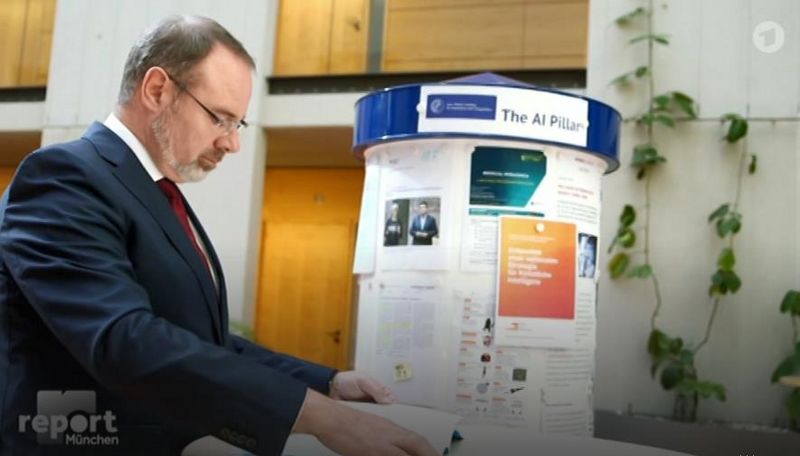
TV report with interview of Dietmar Harhoff
Miscellaneous  |  10/02/2018

Artificial Intelligence: Germany’s prosperity and future at risk

TV report with interview of Dietmar Harhoff

TV report with interview of Dietmar Harhoff
Photo: TV report with interview of Dietmar Harhoff

Artificial Intelligence is considered the key technology of the future – no car, no hospital, no plant will work any longer without it. The US and China have long since realized that. They pour billions in research and development. Their companies set now the standards for the technology. Experts warn: Germany’s prosperity and future is at risk.


More info on this subject (in German):
Eckpunkte einer nationalen Strategie für Künstliche Intelligenz
Artificial Intelligence – New Research Alliances, Short comment by Dietmar Harhoff and Stefan Heumann
 

Miscellaneous  |  07/15/2018

Artificial Intelligence – New Research Alliances

Digital transformation of economic systems in full swing

Many observers see this also as a transition to a data driven economy. However, data alone do not provide added value, they require processing in intelligent data analysis systems using new business models. Here, artificial intelligence (AI) will play an important role, since research funding alone does not create added value effects. Well-functioning AI ecosystems are essential to translate excellent research into societal benefits.

Short comment by Dietmar Harhoff and Stefan Heumann in ZBW Wirtschaftsdienst 2018 (7): 7 (in German)

Miscellaneous  |  05/30/2018

Eckpunkte einer nationalen Strategie für Künstliche Intelligenz

Eine nationale KI-Strategie sollte sich nicht nur auf die Erforschung einzelner Technologien fokussieren, sondern den Aufbau und die Förderung eines starken und international wettbewerbsfähigen KI-Ökosystems in den Mittelpunkt stellen 

Paper by Dietmar Harhoff, Stefan Heumann, Nicola Jentzsch and Philippe Lorenz, Stiftung Neue Verantwortung, 05/30/2018

Download: Outline for a German Artificial Intelligence Strategy (pdf)